
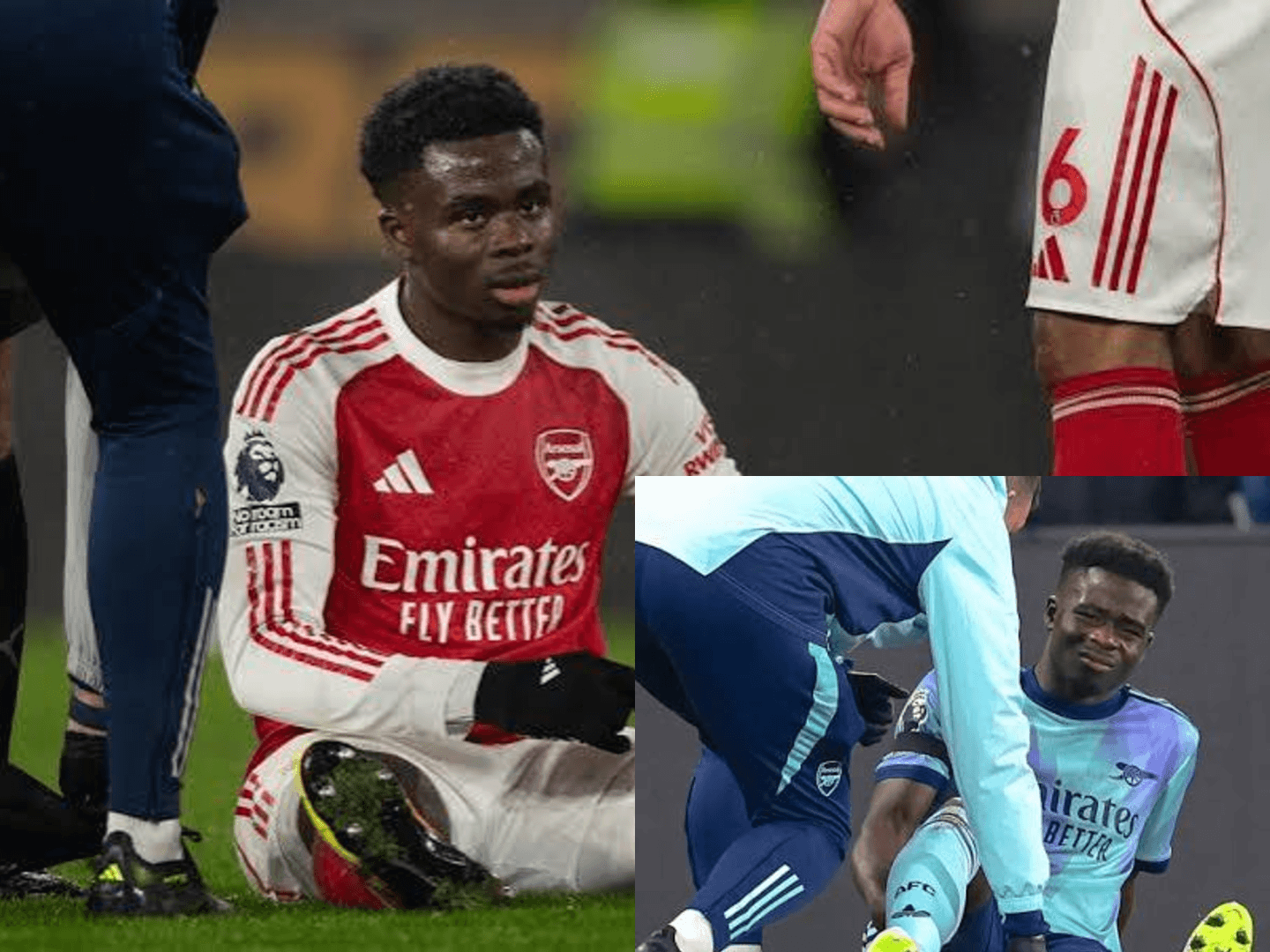
Bukayo Saka’s fitness has been one of the most closely watched narratives in English football throughout 2026. The Arsenal winger has navigated a persistent Achilles injury while helping his club secure the Premier League title and representing England at the World Cup. This article tracks Saka’s injury timeline from March 2026 through his return to action, covering the treatment decisions, tournament management, and current status.
The Achilles Injury and Its Origins
Bukayo Saka first sustained an Achilles injury in March 2026, an issue that would linger for months and require careful management from both Arsenal and England medical teams . The injury proved persistent enough that Saka was unable to train fully between matches during the crucial run-in of the domestic season . Despite the discomfort, the 24-year-old made the decision to play through the pain to help Arsenal secure its first Premier League title in more than two decades . He also appeared in the Champions League final against Paris Saint-Germain, which Arsenal lost on penalties, further delaying any opportunity for proper recovery .
Thomas Tuchel, the England manager, later confirmed that Arsenal had taken good care of Saka but that the winger was still operating below his peak fitness. Tuchel noted that Saka was missing the ability to train on consecutive days, a clear sign that the injury was far from resolved . The decision to let Saka play through pain was a collective one between the player, Arsenal, and the medical staff, particularly when the title was on the line against Fulham . Saka himself acknowledged the gamble, stating that he was happy to put himself out there even when not feeling his sharpest, knowing that people would judge his performances regardless of his physical state .
World Cup 2026 and Managing Fitness
The injury issue followed Saka to the World Cup in North America, where his minutes were strictly limited throughout the tournament . Thomas Tuchel confirmed that Saka was still recovering and required careful management, noting that the player was still not operating at 100 percent . Saka started only one match at the tournament, playing 63 minutes against Panama, and was otherwise restricted to substitute appearances of 18 minutes against Croatia and 25 minutes against Ghana .
The decision to bring Saka to the World Cup drew criticism from several prominent pundits. Roy Keane questioned whether Saka should have been in the squad at all, suggesting that if a player is not fully fit, he should be resting rather than competing . Gary Neville expressed concern that Saka did not look right physically and doubted whether the winger was trusting his body . Ian Wright also voiced worry, noting that Saka was trying to play through the World Cup but that the upcoming season would start soon afterward, leaving little time for proper rest . Neville drew comparisons to past tournaments where players like Wayne Rooney and David Beckham arrived not fully fit and struggled to regain their sharpness, observing that tournaments are not the place to build fitness .
Despite these concerns, Saka remained confident in his ability to contribute. He told reporters that he was feeling better than he had in March and that he was ready to go, while acknowledging that the medical teams from both Arsenal and England had managed him exceptionally well . His commitment to the cause was evident when he scored a hat-trick in the third-place play-off victory over France, a performance that ignited his hunger for the new season . By the end of the tournament, Saka had played through the pain barrier, but the underlying Achilles problem had not been fully resolved.Quick Bio: Bukayo Saka
No Surgery Required
Following England’s World Cup campaign, attention turned to how Arsenal would manage Saka’s long-term fitness. Reports in July 2026 confirmed that Saka would not require surgery on his Achilles injury, a decision that came as a major relief to the club and its supporters . The option of surgery had been mooted as a potential solution, particularly given that the injury had first emerged in March and had persisted through the end of the season and into the World Cup . However, the medical team ultimately decided against an operation, instead opting for a conservative approach that would allow natural recovery .
Under this plan, Saka was given a three-week break to rest and recuperate before returning to Arsenal for pre-season training . The thinking was that this rest period would help the Achilles tendon recover without the risks and extended recovery time associated with surgery . The decision was particularly important given that Saka had been playing with discomfort for months, and a prolonged absence could have derailed Arsenal’s title defense . Avoiding surgery meant Saka could return to training sooner and be ready for the new season, though questions remained about whether the injury would flare up again under the physical demands of another Premier League campaign .
Saka’s Approach to Recovery
Bukayo Saka’s approach to his recovery demonstrated his determination to return to peak condition as quickly as possible. Rather than taking an extended break after the World Cup, Saka took only seven days off before resuming training . He explained that the key was balancing time off with maintaining his sharpness, and he reported back to Arsenal’s London Colney training ground two days early . This proactive approach reflected his hunger to hit the ground running after what he described as a challenging and mentally taxing summer . Saka admitted that the World Cup had not gone how he wanted, but he put the tournament behind him mentally and focused on preparing for the new season with Arsenal .
The hard work paid off. In Arsenal’s Premier League opener against Coventry City, Saka started and scored in a 3-0 victory, putting concerns over his fitness firmly to bed . By that point, the World Cup injury frustration had become a distant memory, and Saka was able to focus on helping Arsenal defend its title . Mikel Arteta confirmed that both Saka and Declan Rice were available for the match, though neither was necessarily a lock to start given they had been playing catch-up in pre-season after late returns from World Cup duty . Saka was expected to play limited minutes, approximately 60, but his goal and overall performance suggested he was close to full match sharpness .
Injury History and Context
Bukayo Saka’s injury history provides important context for understanding his current situation. According to detailed injury records, Saka missed 29 days and seven matches due to Achilles tendon problems in the 2025-26 season . He also suffered a hip injury in January 2026 that cost him 13 days and three matches, and across the entire season, he missed a total of 68 days and 15 matches due to various injuries . This is a significant workload for any player, particularly one of Saka’s age and importance to his team.
The concern among analysts is that Saka’s physical condition could affect Arsenal’s performance in the upcoming season. Jeremie Aliadiere, a former Arsenal player, identified Saka along with William Saliba and Declan Rice as three players who could significantly influence the Gunners’ campaign, though he noted that their success may depend on their fitness . Aliadiere observed that while Saka and Rice were expected to return to the squad soon, the critical question was how long it would take for them to regain full fitness and whether Arsenal could perform optimally in their absence . The comparison with other top Premier League players is instructive. Jamie Carragher noted that a couple of years ago, Saka and Martin Odegaard appeared close to reaching the levels shown by players like Kevin De Bruyne and Erling Haaland at Manchester City or Mohamed Salah and Sadio Mane at Liverpool . Carragher suggested that injuries had prevented Saka from making that next step, but he remained optimistic that the Arsenal star could get back to where he was .
Looking Ahead
The outlook for Bukayo Saka and Arsenal is broadly positive. With the decision to avoid surgery and the successful return to action against Coventry, Saka appears to have put his injury problems behind him . His commitment to training and his hunger to perform suggest he will be a key figure in Arsenal’s title defense. However, the history of his injuries in the 2025-26 season serves as a reminder that careful management will be required to keep him fit throughout the campaign. The Premier League is demanding, and Saka is a player who opponents target with physical challenges, making him vulnerable to further issues . Mikel Arteta will need to balance Saka’s importance to the team with the need to protect his long-term fitness, possibly rotating him more than in previous seasons . For now, though, Saka is fit, available, and ready to lead Arsenal’s attack.What type of injury has Bukayo Saka been dealing with?
Bukayo Saka has been managing a persistent Achilles tendon injury. The issue first emerged in March 2026 and continued to trouble him through the end of Arsenal’s domestic season and into the World Cup in North America .
Did Bukayo Saka need surgery for his Achilles injury?
No. Reports from July 2026 confirmed that Saka would not require surgery on his Achilles tendon. Instead of an operation, the medical team opted for a conservative approach with a three-week rest period to allow for natural recovery .
Was Bukayo Saka fully fit for the 2026 World Cup?
Saka was not fully fit for the World Cup. England manager Thomas Tuchel confirmed he was “not 100 per cent” and could not train on consecutive days. His minutes were managed throughout the tournament, with Saka himself acknowledging he was “happy to gamble” with his fitness .
When did Bukayo Saka return to action for Arsenal?
Saka returned to action for Arsenal’s Premier League opener against Coventry City in August 2026. Manager Mikel Arteta confirmed he was fit and available, and Saka started the match, scoring in the 3-0 victory .
What is Bukayo Saka’s overall injury history?
According to detailed injury records, Saka missed 68 days and 15 matches across three separate injuries in the 2025-26 season. Alongside the Achilles problem, he also sustained a hip injury in January 2026 and a hamstring injury in August 2025 .
